


Why Capacitor Failure Is the Most Common AC Repair — and What It Means for Your Home
Capacitor failure why it is the most common AC repair is a question worth understanding before your AC stops working on the hottest day of the year. In fact, capacitor problems account for roughly 30% of all AC service calls — more than any other single component failure, including contactors, fan motors, and compressors.
Here is a quick breakdown of why this happens so often:
- Every AC system has at least one capacitor — most have two — making it statistically the most likely part to fail
- Capacitors handle enormous electrical stress every single time your system starts up
- Heat is their biggest enemy, and Northern Utah summers push outdoor units hard
- They wear down gradually, often failing without warning — similar to a light bulb burning out
- When they fail, the whole system stops — no cooling, no airflow, no comfort
For homeowners in North Ogden and across Northern Utah, an AC that hums but won’t start, blows warm air, or shuts off mid-cycle is a classic sign that a capacitor is struggling. It is one of the most common calls Anderson HVAC receives every summer — and one of the most important to catch early before it takes out your compressor with it.
Understanding the Role of the AC Capacitor in Your Cooling System
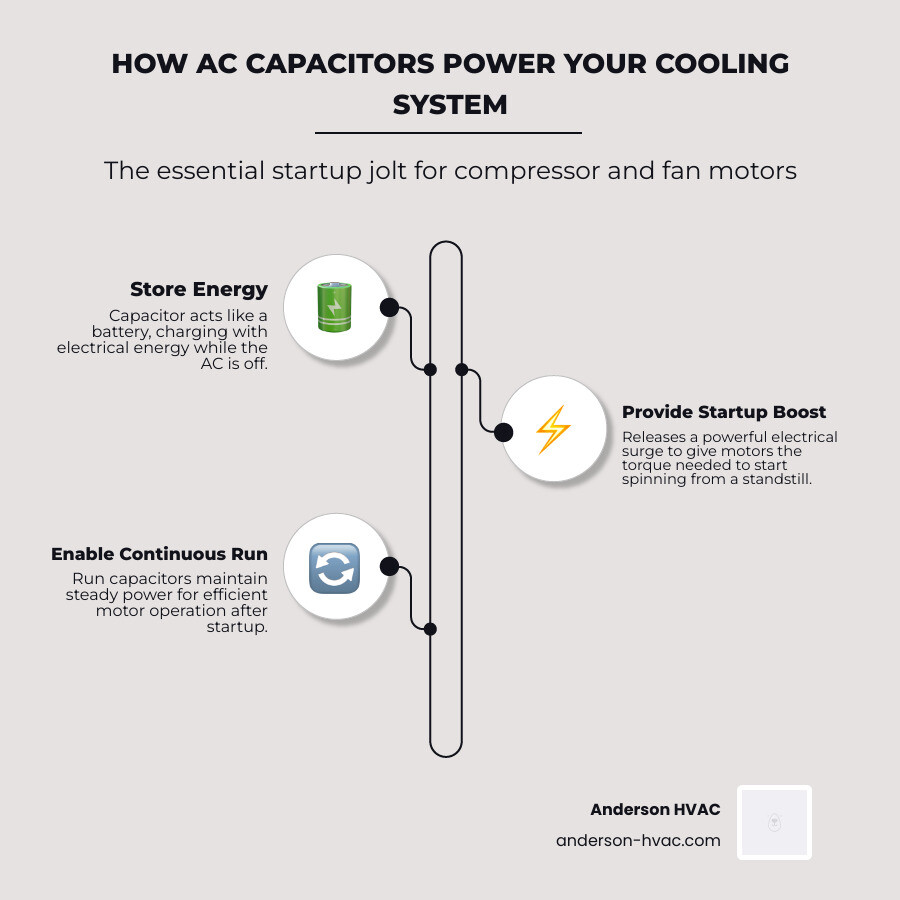
To understand why this part fails so often, we first need to look at what it actually does. Think of your AC capacitor as a high-powered energy storage device. It functions similarly to a rechargeable battery, but instead of releasing energy slowly over hours, it releases a massive, concentrated “jolt” of electricity in a fraction of a second.
This burst of energy is required for motor startup. AC motors—specifically the compressor and the outdoor fan motor—require much more power to get moving from a dead stop than they do to keep spinning once they are already in motion. Without that extra “oomph” from the capacitor, your motors would simply sit there and hum until they overheated and burned out.
In modern systems, you might find several different types of capacitors. Some units use separate start and run capacitors, while many residential units in our area use a “dual run” capacitor. This single component handles both the compressor and the fan motor, making it a critical single point of failure. If you are experiencing issues in Davis County, getting an expert AC repair in Clearfield UT is the best way to ensure these electrical components are matched correctly to your system.

The Difference Between Start and Run Capacitors
While they look similar—usually small, silver cylinders—start and run capacitors have very different jobs:
- Start Capacitors: These provide the massive torque boost needed to get the motor moving. Once the motor reaches about 75% of its full speed, the start capacitor drops out of the circuit.
- Run Capacitors: These stay active the entire time the motor is running. They help regulate the voltage and current, ensuring the motor runs efficiently and maintains a steady speed. They are measured in microfarads (µF), and even a small drop in this rating can cause your motor to run hot and consume more energy.
How Capacitors Act as the System’s Spark Plug
If your AC were a car, the capacitor would be the spark plug. It provides the “ignition” needed to start the cooling cycle. When your thermostat calls for cooling, the capacitor discharges its stored energy to ignite the compressor. Once the “engine” is running, the capacitor begins recharging itself from the main power line, waiting for the next cycle. This constant cycle of discharging and recharging is why capacitor failure why it is the most common AC repair is a reality for so many homeowners; it is a part that is literally designed to wear out over time.
Capacitor Failure: Why It Is the Most Common AC Repair
At Anderson HVAC, we’ve seen it all in our 40+ years of service, but nothing tops the frequency of the “blown cap.” It is consistently among the top five summer repairs and is the single most common part to fail in any HVAC system.
The reason is simple: sensitivity. Capacitors are made of thin layers of metal film and electrolyte oil. They are incredibly sensitive to their environment. While a compressor is a heavy-duty piece of machinery, the capacitor is a delicate electrical component that bears the brunt of every power fluctuation and heatwave.
Capacitor Lifespan by Climate (Estimated)
| Climate Type | Typical Lifespan | Primary Stressor |
|---|---|---|
| Mild/Coastal | 12–15 Years | Salt Air Corrosion |
| High Humidity | 5–10 Years | Electrical Arcing |
| Northern Utah (High Heat/Dry) | 5–7 Years | Thermal Degradation |
Whether you are chilling out in Clinton with professional AC services or living in the higher elevations of Huntsville, your capacitor is working overtime during our peak summer months.
Recognizing the Symptoms of Capacitor Failure Why It Is the Most Common AC Repair
You don’t always need a multimeter to know something is wrong. Here are the common red flags:
- The “Hum of Death”: You hear the outdoor unit humming, but the fan blades aren’t spinning.
- Clicking Noises: The system tries to start, clicks loudly, and then goes silent.
- Delayed Start: There is a noticeable lag between the thermostat clicking and the AC actually kicking on.
- Warm Air: The indoor fan is blowing, but because the compressor never started, the air isn’t cold.
- Visible Damage: If you look at the capacitor, the top should be perfectly flat. If it looks like a mushroom or is bulging upward, it has failed internally.
Why Capacitor Failure Why It Is the Most Common AC Repair Peaks During Utah Summers
It is now May 2026, and as we head into the heat of another Utah summer, the risk to your capacitor skyrockets. When the outdoor temperature hits 95 degrees, the internal temperature of your AC cabinet can easily exceed 150 degrees.
This extreme heat causes the oil inside the capacitor to expand and eventually leak or dry out. Additionally, during a heatwave, your AC cycles on and off much more frequently. Every time it starts, the capacitor takes a “hit” of electrical stress. If you’re in the Farmington area, don’t wait until the vents are blowing hot air—don’t lose your cool with Farmington AC repair by scheduling a check-up before the July spikes.
The Main Culprits Behind Capacitor Breakdown
While heat is the number one enemy, it isn’t the only thing that kills capacitors. We often find that a combination of factors leads to that mid-summer breakdown.
The Impact of Power Fluctuations and Surges
Northern Utah is no stranger to summer thunderstorms. Lightning strikes or even minor power grid instability can send a surge of voltage through your home. Because capacitors are designed to store electricity, they are often the first part to “pop” when a surge occurs. This causes a dielectric breakdown—essentially a short circuit inside the capacitor that renders it useless.
How Vibration and Poor Maintenance Accelerate Wear
Your AC unit is a vibrating machine. Over time, these vibrations can loosen the “spade” connectors that attach your wires to the capacitor. A loose connection causes electrical arcing, which generates intense heat and melts the capacitor’s terminals.
Furthermore, poor maintenance—like a clogged air filter or dirty outdoor coils—forces the motor to work harder. When the motor struggles, it draws more current, which in turn puts more stress on the capacitor. Keeping your system clean is vital, and seeking Brigham City AC repair for long-term system health can prevent these small issues from becoming big problems.
Protecting Your Compressor from Secondary Damage
The biggest mistake a homeowner can make is ignoring a failing capacitor. You might notice your AC “struggling” to start but eventually catching. This is known as a “hard start,” and it is devastating to your compressor.
The compressor is the heart of your AC system and is significantly more expensive to replace than a capacitor. When a capacitor is weak, the compressor motor has to stay in the “start” phase longer, which generates massive amounts of heat in the motor windings. Over time, this heat melts the insulation on the wires, leading to a total motor burnout. By calling for Farr West AC repair to prevent motor burnout, you are essentially buying insurance for your compressor.
The High Cost of Ignoring a Weak Capacitor
A weak capacitor doesn’t just risk a breakdown; it hits your wallet every month. When a capacitor’s microfarad rating drops below its intended range (usually a 10% tolerance), the motor becomes less efficient. It will draw more Amps to do the same amount of work, leading to a spike in your utility bills. You are paying more for less cooling.
How Technicians Diagnose Failing Components
When we arrive at your home in North Ogden or Roy, we don’t just guess. We use a multimeter to measure the exact capacitance. If a capacitor is rated for 45 µF but is only reading 38 µF, we know it’s on its way out. We also perform a visual inspection for “mushrooming” or oil leaks and check the “Dissipation Factor” to see how much energy is being lost as heat. This predictive maintenance allows us to replace a failing part before it leaves you stranded in a 100-degree house.
Preventive Maintenance to Extend Component Lifespan
We always tell our neighbors in Northern Utah that the best repair is the one you never had to make. While you can’t stop the sun from shining, you can take steps to protect your electrical components.
The Importance of Professional Inspections
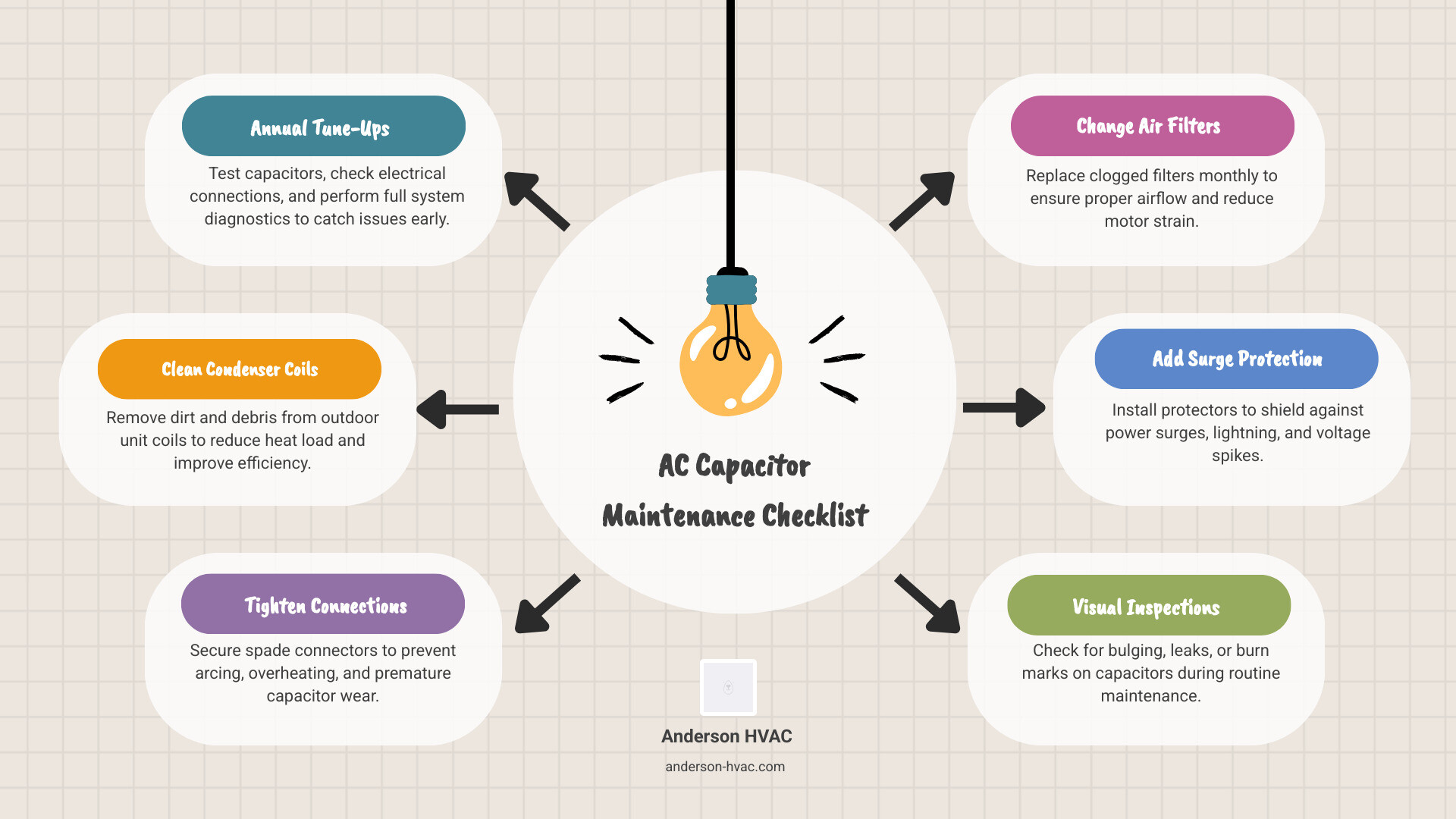
Because capacitors store a lethal electrical charge even when the power is off, inspections should always be handled by pros. During a professional tune-up, we:
- Test the electrical strength of all capacitors.
- Tighten all electrical connections to prevent arcing.
- Clean the condenser coils to reduce the heat load on the system.
- Ensure the capacitor is the correct OEM-match for your specific motor.
Simple Steps to Reduce Thermal Stress
As a homeowner, there are a few things you can do to help:
- Clear Debris: Keep weeds, grass clippings, and “cottonwood” fluff away from your outdoor unit. This ensures better airflow and lower internal temperatures.
- Change Filters: A dirty filter makes the indoor blower motor work harder, which can stress the indoor capacitor.
- Provide Shade: If possible, provide some afternoon shade for your outdoor unit, but ensure there is at least 2-3 feet of clearance for airflow.
- Surge Protection: Consider installing a dedicated HVAC surge protector to shield your delicate electronics from grid spikes.
Frequently Asked Questions about AC Capacitors
How long do AC capacitors typically last?
In our local Northern Utah climate, you can typically expect a capacitor to last between 5 and 7 years. While some high-quality units in shaded areas might last 10-20 years, the combination of our dry summer heat and frequent cycling usually wears them down sooner. If your AC is more than 5 years old, it’s a good idea to have the capacitor tested during your annual spring tune-up.
Can I replace an AC capacitor myself?
We strongly advise against DIY capacitor replacement. Capacitors are essentially large batteries that store high-voltage electricity. Even if you have flipped the circuit breaker, a capacitor can hold enough energy to deliver a dangerous, or even fatal, electrical shock. Additionally, they often contain hazardous oils that require proper handling. Beyond the safety risks, using the wrong size or voltage rating can instantly burn out your expensive compressor, and most manufacturers will void your warranty if the part wasn’t installed by a licensed professional.
What happens if I use the wrong size capacitor?
Using a capacitor with the wrong microfarad (µF) rating is like putting the wrong fuel in your car. If the rating is too low, the motor won’t have enough torque to start or stay at speed, leading to overheating. If the rating is too high, it can provide too much current to the motor windings, causing them to vibrate excessively and eventually melt. Always ensure the replacement part matches the manufacturer’s specifications exactly.
Conclusion
At Anderson HVAC, we take pride in being the family-owned experts that Northern Utah has trusted for over 40 years. We understand that capacitor failure why it is the most common AC repair isn’t just a technical fact—it’s a frustration that can disrupt your family’s comfort. Whether you are in Brigham City, Layton, or right here in North Ogden, we are committed to providing neighborly care and reliable service that exceeds your expectations.
Don’t wait for your AC to fail during a record-breaking heatwave. Let our experienced technicians inspect your system and ensure your “weakest link” is strong enough to handle the summer ahead.
Schedule your professional AC repair in North Ogden today and experience the peace of mind that comes with 40 years of local expertise.

