



Why Your AC Circuit Breaker Keeps Tripping — and What It’s Telling You
AC circuit breaker keeps tripping what it means is simple: your air conditioner is pulling more electricity than the circuit can safely handle, and the breaker is cutting power to protect your home from overheated wires or a potential fire.
Here are the most common reasons this happens:
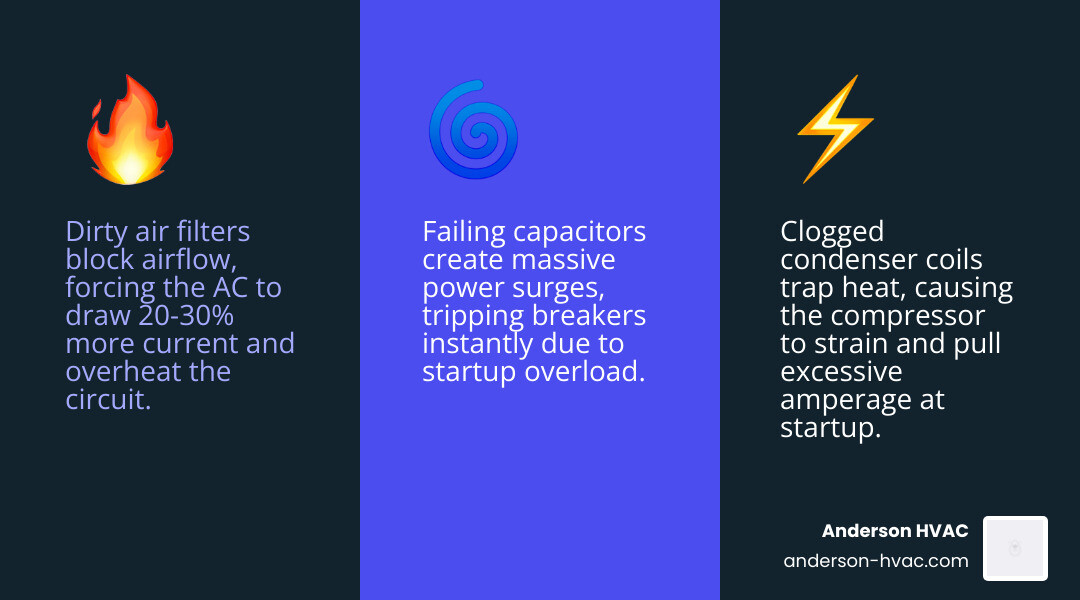
- Dirty air filter — blocked airflow forces the system to work harder and draw more current
- Clogged condenser coils — trapped heat makes the compressor strain to do its job
- Failing capacitor — a weak capacitor causes the compressor to demand a massive power surge at startup
- Shorted or grounded compressor — a direct electrical fault that trips the breaker instantly
- Worn-out circuit breaker — the breaker itself may be too old to handle the load reliably
- Loose or damaged wiring — faulty connections create resistance and heat inside the panel
Think of the breaker as a smoke alarm for your wiring. When it trips, it is not the problem — it is the warning sign.
If your AC keeps tripping the breaker in Northern Utah, that is your system telling you something is wrong. Ignoring it or repeatedly resetting the breaker without finding the cause can lead to permanent equipment damage or, in serious cases, an electrical fire. This guide walks you through what is happening, what you can safely check yourself, and when to call a professional.
Understanding What It Means When Your AC Circuit Breaker Keeps Tripping
When we talk about ac circuit breaker keeps tripping what it means, we are looking at a safety mechanism in action. Your home’s electrical panel is designed to monitor the “amperage draw” of every appliance. Every circuit breaker has a specific limit—for example, a 20-amp breaker is designed to “trip” or shut off if the power draw hits 30 amps.
In our 40+ years of experience serving Northern Utah, we have seen many homeowners treat a tripped breaker like a minor nuisance, much like a flickering lightbulb. However, an electrical overload is a serious event. The breaker is a circuit protection device; it stops the flow of electricity before the wires in your walls get hot enough to melt their insulation. If you are looking for local insights on keeping your system running smoothly, check out our Chilling Out in Clinton: A Local’s Guide to AC Repair Services.
ac circuit breaker keeps tripping what it means for your system’s safety
The primary goal of a breaker is to prevent an electrical fire. When an AC unit malfunctions, it can create a “short circuit” (where electricity takes a shortcut it shouldn’t) or a “ground fault” (where electricity leaks into the metal frame of the unit). Without a functioning breaker, these faults would continue to generate intense heat, potentially igniting nearby building materials. By “tripping,” the breaker is effectively saving your equipment and your home.
Why the Breaker Trips Immediately vs. After Running
Timing is a huge clue for our technicians.
- Immediate Trips: If the breaker flips the second the AC tries to kick on, we usually suspect a “locked rotor” or a direct electrical short. This is often a startup surge issue where a component has failed completely.
- Tripping After 20-30 Minutes: If the unit runs for a while before the power cuts, it usually points to heat buildup. As the unit struggles with a continuous load—perhaps due to dirty components—it gets hotter and hotter, drawing more current until it finally crosses the safety threshold.
Common Mechanical Causes for Electrical Overloads
It might surprise you that a mechanical problem can lead to an electrical failure. Most issues with ac circuit breaker keeps tripping what it means actually start with airflow restriction. When air can’t move freely through your system, the motors have to work double-time. This extra effort requires more “juice,” which eventually overloads the circuit.
For more information on keeping your air pathways clear, see our info about filtration services.
Common mechanical triggers include:
- Clogged or “impacted” air filters.
- Dust-coated evaporator coils (the indoor part of your AC).
- Leaves, grass clippings, or cottonwood seeds blocking the outdoor unit.
- Blocked or closed supply vents in your home.
ac circuit breaker keeps tripping what it means for your compressor’s lifespan
The compressor is the “heart” of your AC, and it is also the most expensive part to replace. When a breaker trips due to mechanical strain, it means your compressor is overheating and operating under high pressure. This leads to lubrication failure, where the oil inside the compressor breaks down. If the breaker keeps tripping and you keep resetting it, you are essentially forcing a “heart attack” on your system, significantly shortening its lifespan.
How a Dirty Air Filter Causes the AC Breaker to Trip
Imagine trying to breathe through a thick pillow while running a marathon. That is what your blower motor feels like when the air filter is caked with dust. To maintain the same cooling power, the motor draws more and more current to overcome the “static pressure” of the clog. Eventually, the energy consumption hits a level the breaker won’t allow. This is why monthly maintenance is the simplest way to prevent electrical issues.
Identifying Failing Components and Electrical Shorts
Sometimes, the issue isn’t dirt—it’s a part that has simply reached the end of its life. In areas like Farr West, where summer temperatures can fluctuate, components like capacitors take a beating. If you’re dealing with these issues, you might find our guide on Farr West AC Repair: Finding the Best and Most Affordable Services helpful.
Signs of a Shorted Motor or Electrical Short
An electrical short occurs when the insulation on the wires inside a motor breaks down. This can happen due to age, vibration, or even rodents chewing on the lines.
- Burning Smell: This is a major red flag. If you smell ozone or burning plastic near your vents or the outdoor unit, shut the power off immediately.
- Buzzing Sound: A failing motor or contactor often makes a distinct chattering or buzzing noise before the breaker trips.
- Visual Damage: Frayed wiring or scorch marks inside the service panel are clear indicators of an insulation breakdown.
The Role of the Hard Start Kit
As compressors age, they sometimes struggle to generate the “torque” needed to start spinning. This causes a massive voltage drop and a spike in amperage. A “hard start kit” acts like a battery boost, providing the extra jolt needed to get the compressor moving quickly. This can be a great solution for older equipment that is otherwise healthy but occasionally trips the breaker on startup.
The Dangers of Repeatedly Resetting Your Breaker
We cannot emphasize this enough: do not keep flipping the switch. If the breaker trips once, you can try to reset it. If it trips a second time, stop.
Repeatedly forcing electricity into a faulted system creates a massive fire hazard. Every time you reset that breaker, you are potentially causing an “arc fault”—a spark that can reach thousands of degrees. For residents in the Farmington area, we provide specialized support to prevent these disasters; learn more at Don’t Lose Your Cool with Farmington AC Repair.
Risks to Internal AC Components
Beyond the fire risk, you are actively destroying your AC unit. Continuous overcurrent events can cause:
- Compressor Burnout: The internal windings melt, turning the refrigerant into a thick, acidic sludge.
- Motor Seizure: The fan motors can literally weld themselves shut from the heat.
- Control Board Failure: Sensitive electronics can be fried by the power surges.
When to Stop Attempting a Reset
You should immediately stop and call for help if you experience:
- An immediate trip (the breaker won’t even stay in the “on” position).
- Any smoke detection or the smell of burning.
- Visible sparks or a “pop” sound from the electrical panel.
- The breaker feels hot to the touch.
Safe Troubleshooting and Prevention for Northern Utah Homeowners
As of May 2026, many modern AC units have built-in diagnostics, but the basics of maintenance remain the same. Whether you need AC Repair in Clearfield UT or are looking for Brigham City AC Repair, there are a few things you can safely do at home.
Simple Steps to Perform at Home
Before you call us, perform these quick checks:
- Filter Replacement: Ensure your filter is clean. This is the #1 cause of airflow-related trips.
- Debris Clearance: Walk outside and check your condenser. Ensure there are at least two feet of clear space around the unit. Remove any leaves or overgrown bushes.
- Vent Obstruction: Make sure you haven’t blocked your return air grilles with furniture or curtains.
- Coil Rinsing: You can gently rinse the outdoor coils with a garden hose (do not use a pressure washer, as this will flatten the delicate fins).
How Regular Maintenance Prevents Future Trips
The best way to handle ac circuit breaker keeps tripping what it means is to prevent it from happening in the first place. Annual tune-ups allow our technicians to:
- Tighten loose electrical connections that have vibrated loose over the winter.
- Test the “capacitance” of your capacitors to ensure they aren’t weakening.
- Check refrigerant levels; low refrigerant causes the compressor to run longer and hotter.
- Clean the coils professionally to ensure maximum heat transfer.
Frequently Asked Questions About Tripping Breakers
Can extreme heat or high humidity cause my breaker to trip?
Yes. On those scorching Northern Utah afternoons, the “ambient temperature” is already high, making it harder for the outdoor unit to release heat. This increases the system load. If your coils are even slightly dirty, the combination of extreme heat and poor heat transfer can push the amperage draw over the limit.
Is it safe to reset the breaker once?
Generally, yes. Sometimes a “fluke” trip happens due to a power surge from the utility grid or a nearby lightning strike. We recommend turning your thermostat to “off,” resetting the breaker, and waiting about 30 minutes before turning the AC back on. This gives the internal components time to cool down. If it trips again, it is not a fluke.
When should I call a professional technician?
If the breaker trips more than once, if you smell burning, or if the unit is making strange noises, it’s time to call. Working with high voltage (240V) and pressurized refrigerants requires specialized tools and expertise. Our team at Anderson HVAC has the training to diagnose the root cause safely and accurately.
Conclusion
A tripping breaker is your home’s way of asking for help. While it can be tempting to just “flip the switch” and get back to your day, understanding ac circuit breaker keeps tripping what it means can save you from a much larger repair bill—or a dangerous home fire.
At Anderson HVAC, we are a family-owned business with over 40 years of experience serving North Ogden and the surrounding Northern Utah communities. We treat every home like our own, providing individualized service that exceeds expectations. If your AC is giving you trouble, don’t wait for a total system failure. Schedule your professional AC repair or maintenance today and let our family take care of yours.