




When Your AC Blows Warm Air: What It Means and What to Do
If you’re searching for why is my ac blowing warm air troubleshooting steps, here’s a quick answer before we dive deeper:
Quick Troubleshooting Steps:
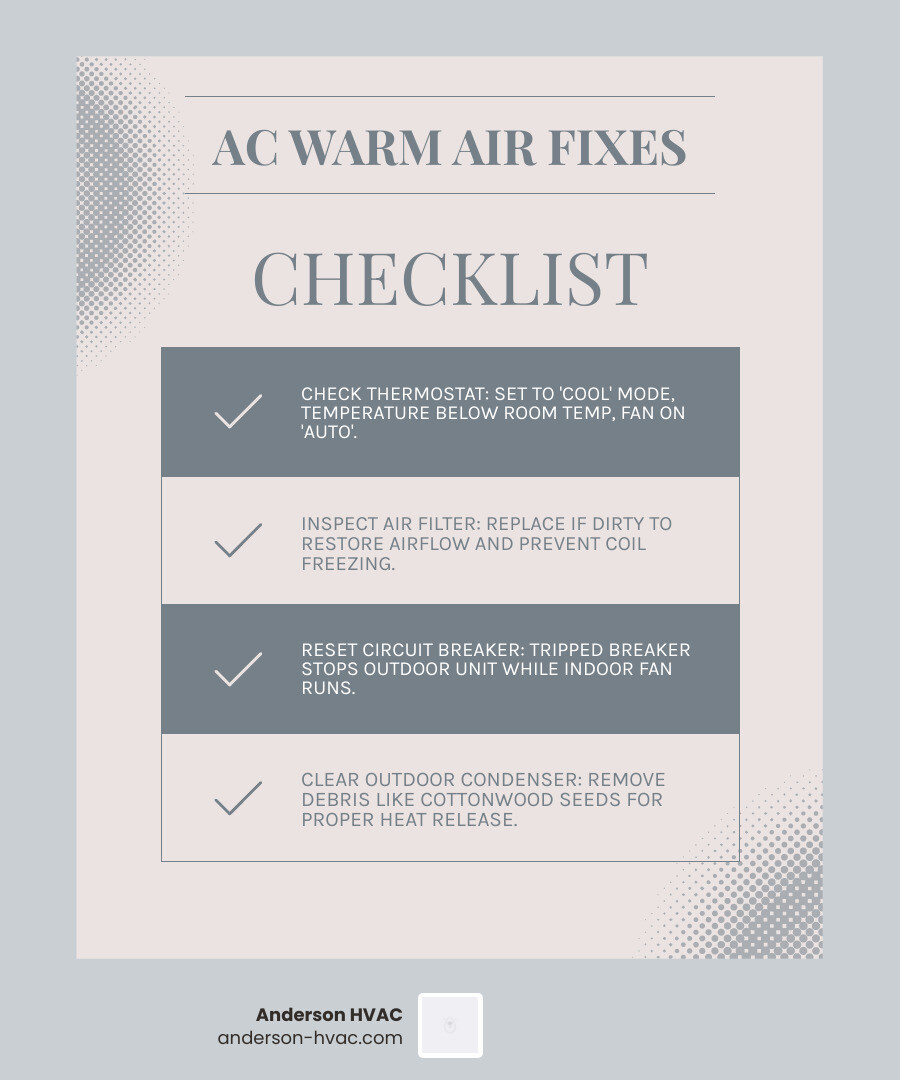
- Check your thermostat — Make sure it’s set to “Cool” mode and the temperature is lower than the current room temperature. Set the fan to “Auto,” not “On.”
- Inspect your air filter — A clogged filter restricts airflow and is one of the most common causes of warm air output. Replace it if it looks dirty.
- Check your circuit breaker — A tripped breaker can cut power to the outdoor unit while the indoor fan keeps running. Reset it once if tripped.
- Look at the outdoor condenser unit — Make sure it’s running, clear of debris, and not covered in dirt or cottonwood seeds (a very real issue here in Northern Utah).
- Check for ice on the indoor unit or refrigerant lines — Visible ice means the evaporator coil may be frozen. Turn the system off and let it thaw.
- Listen for unusual sounds — Hissing, bubbling, or rattling near the unit can point to a refrigerant leak or a failing component.
- Call a professional — If the steps above don’t resolve the issue, it’s time to bring in a licensed HVAC technician.
There’s little worse on a sweltering Northern Utah summer day than walking up to a vent and feeling warm air pouring out instead of the cool relief you expected. Whether your system is brand new or has been running for a decade, this problem can catch any homeowner off guard — and it tends to happen at the worst possible time.
The good news? Many of the most common causes of an AC blowing warm air are straightforward to identify. Understanding what’s going wrong — and knowing which steps you can safely take yourself — can save you time, stress, and unnecessary service calls.
In this guide, we’ll walk through every major cause and what to do about it, from simple thermostat fixes to signs that your system needs professional attention from the team at Anderson HVAC.
Why is my ac blowing warm air troubleshooting steps for Northern Utah homes
When your air conditioner is running but not cooling, the problem usually boils down to a disruption in the heat exchange process. Your AC doesn’t actually “create” cold air; it removes heat from the indoor air and transfers it outside. This process relies heavily on unrestricted airflow.
In May 2026, as we see record-breaking temperatures across the Wasatch Front, the most frequent culprit behind warm air is a simple lack of maintenance. Specifically, a dirty air filter is the number one reason an AC struggles. When the filter is packed with dust, pet dander, or Utah’s famous seasonal pollen, the system can’t pull in enough air to cool it down. This causes the internal components to strain, often leading to a total system shutdown or, paradoxically, a frozen unit.
Beyond the filter, you should check your return grilles. If you’ve recently rearranged furniture in your home, you might have accidentally blocked the very vents your system needs to “breathe.” Ensuring a clear path for air to enter and exit the system is the first step in restoring comfort. For those living in areas like Clearfield, keeping your system clear of local environmental debris is essential. You can learn more about local care in our guide on AC Repair in Clearfield, UT: A Breath of Fresh Air for Your Car and Home.
Why is my ac blowing warm air troubleshooting steps for thermostat settings
Sometimes the solution is so simple we overlook it. Before panicking about a broken compressor, take a close look at your thermostat.
- The “Fan” Setting: If your thermostat fan is set to “On” instead of “Auto,” the blower will run constantly, even when the cooling cycle is off. This means it’s simply pushing unconditioned, room-temperature air through your vents between cooling cycles, making it feel like the AC is blowing warm air.
- Mode Selection: It sounds silly, but check that it hasn’t been accidentally switched to “Heat.” In a busy household, it only takes one person feeling a chill to flip the switch and forget to change it back.
- Power Issues: If the display is blank or flickering, your thermostat might just need new batteries. Without a steady signal, it can’t tell the outdoor unit to start the cooling process.
If your settings are correct but the house remains hot, there might be a calibration or wiring issue. Residents in Farr West can find more specific advice on navigating these common glitches in our article on Farr West AC Repair: Finding the Best and Most Affordable Services.
Inspecting ductwork for leaks and blockages
Did you know the average home can lose 20 to 30 percent of its conditioned air through leaky or poorly connected ducts? If your AC unit is working perfectly but you’re still feeling warm air, the cool air might be escaping into your attic or crawlspace before it ever reaches your living room.
Vents can also become obstructed by household items or internal debris. If you have a ductless system, which is becoming increasingly popular in Kaysville, the troubleshooting steps are slightly different but the goal remains the same: ensuring the air has a clear path. If you’re using a mini-split, check out Why Your Kaysville Home Needs Professional Ductless AC Repair Right Now for targeted tips.
Identifying Airflow and Mechanical Blockages
If your indoor checks don’t reveal the problem, the issue is likely mechanical. In fact, about 90% of the time, when an AC blows warm air but you can still feel air moving, the problem is located in the outdoor condenser unit. This unit is responsible for releasing the heat collected from inside your home. If it can’t breathe, the heat stays inside.
Why is my ac blowing warm air troubleshooting steps for outdoor condenser units
In Northern Utah, our outdoor units face a unique challenge: cottonwood seeds. These fluffy white seeds can act like a blanket, wrapping around your condenser coils and choking off airflow. When the coils are dirty or blocked by grass clippings and debris, the refrigerant can’t release the heat it absorbed from your house.
Actionable Steps for the Outdoor Unit:
- Turn off the power: Use the disconnect switch near the unit or the breaker in your panel.
- Clear the perimeter: Ensure there is at least two feet of clear space around the unit. Remove weeds, tall grass, or stored items.
- Gently rinse the coils: Use a garden hose (not a pressure washer!) to wash away dirt and seeds from the fins.
- Check the fan: While the power is on, observe if the large fan on top of the unit is spinning. If it’s stationary, you likely have a failed motor or capacitor.
For those in Harrisville looking for a roadmap to keeping these units running, see Your Harrisville Ductless Air Conditioning Repair Roadmap. If you’re in Clinton and want to avoid “losing your cool” while cleaning your unit, we have a guide for that too: How to Fix Your Clinton Home’s Ductless AC Without Losing Your Cool.
Managing a frozen evaporator coil
It seems counterintuitive, but your AC can actually freeze solid in the middle of a 90-degree day. When airflow is restricted (due to a dirty filter) or refrigerant is low, the evaporator coil inside your home can drop below freezing. Moisture in the air then turns to ice on the coil, creating a literal wall of ice that blocks airflow.
If you see ice on the copper lines leading into your house or notice a “sweating” indoor unit, you have a frozen coil. Turn the system off immediately. Running it while frozen can lead to a “slugged” compressor — a very expensive repair. Switch the fan to “On” to help thaw the ice, but be prepared for some water in your drain pan as it melts. For West Point residents, we’ve shared some West Point’s Best Kept Secrets for Reliable Ductless AC Repair that cover these freezing scenarios.
Signs of Refrigerant Leaks and Electrical Failures
If you’ve checked the filters, the thermostat, and the outdoor unit, and you’re still sweating, we may be looking at a refrigerant or electrical failure. These issues are more technical and often require the specialized tools of an Anderson HVAC technician.
Identifying compressor and capacitor issues
The capacitor is like a giant battery that gives your AC motor the “kick” it needs to start. In the heat of a Utah summer, these components are under immense stress and are one of the most common electrical parts to fail. If you hear a humming sound coming from your outdoor unit but the fan isn’t spinning, a failed capacitor is likely the cause.
The compressor is the “heart” of your system. If it fails, the refrigerant can’t circulate, and the cooling process stops entirely. Listen for unusual “clunking” or “rattling” sounds (some homeowners describe it as “coins in a dryer”). These are warning signs that the compressor is struggling. For our neighbors in Morgan, you can find more on these electrical components in Your Local Guide to Ductless Mini-Split Repair Services in Morgan.
Recognizing refrigerant insufficiency
Refrigerant is the lifeblood of your AC. Contrary to popular belief, an AC does not “use up” refrigerant like a car uses gas. It is a closed loop. If your refrigerant is low, it means you have a leak.
Signs of a refrigerant leak include:
- Hissing or bubbling noises near the lines.
- Ice buildup on the refrigerant lines.
- An AC that runs constantly but never reaches the set temperature.
- Significantly higher-than-normal energy bills.
Because refrigerant handling requires EPA certification, you should never attempt to “top it off” yourself. Adding refrigerant without fixing the leak is a temporary and expensive patch. If you’re in Clinton or Farmington, we can help diagnose these leaks properly. Check out Chilling out in Clinton: A Local’s Guide to AC Repair Services or Don’t Lose Your Cool with Farmington AC Repair for more details.
Preventing Future Cooling Issues with Regular Maintenance
The best way to handle an AC blowing warm air is to prevent it from happening in the first place. Regular maintenance is the “secret sauce” for a long-lasting, efficient system. Most residential air conditioners are designed to last 15 to 20 years, but without a yearly tune-up, that lifespan can be cut in half.
At Anderson HVAC, we’ve seen that 90% of emergency repair calls could have been avoided with a simple spring inspection. During a professional tune-up, we clean the coils, check refrigerant levels, test the capacitors, and ensure your ductwork is sealed.
| Feature | Professional Maintenance | System Neglect |
|---|---|---|
| Energy Bills | 30-40% lower with high efficiency | Increases as system struggles |
| Lifespan | 15 – 20 years | 7 – 10 years |
| Air Quality | Improved via clean filters/coils | Poor due to dust/mold buildup |
| Reliability | Rare emergency breakdowns | Frequent mid-summer failures |
Keeping your system maintained not only ensures your comfort but also protects your wallet. For those in Brigham City, staying ahead of the heat is key. Learn more at Brigham City AC Repair: Keeping Your Home Chilled and Your Wallet Full.
Frequently Asked Questions and Conclusion
At Anderson HVAC, we are a family-owned business with over 40 years of experience serving the Northern Utah community. From our home base in North Ogden, we’ve helped thousands of families in Roy, Layton, Kaysville, and beyond stay cool when the temperatures climb. We pride ourselves on individualized service that exceeds expectations — because we care about your comfort as much as you do.
Common AC Warning Signs:
- Warm air coming from vents.
- Frequent cycling (turning on and off).
- Unusual noises (hissing, grinding, or clicking).
- Strange odors (musty or burning smells).
- Water pooling around the indoor unit.
Should I turn off my AC if it is blowing warm air?
Yes! If your AC is blowing warm air, it is often a sign of a frozen coil or a mechanical strain. Keeping it running can cause permanent damage to the compressor. Turn it off at the thermostat and perform the basic checks (filter and outdoor unit) before calling for service.
How long does it take to fix common AC warm air issues?
Simple issues like a dirty filter or a tripped breaker can be fixed in minutes. Electrical repairs like replacing a capacitor usually take about an hour for a professional. However, if you have a significant refrigerant leak or a failed compressor, the repair could take several hours or even require a follow-up visit.
What are the signs that my AC system needs replacement?
If your system is over 15 years old, requires frequent repairs, or your energy bills are skyrocketing, it might be time for an upgrade. Modern high-efficiency systems can reduce your cooling costs by 30 to 40 percent annually, often paying for themselves over time.
Don’t spend another minute in a hot house. Whether you’re in Pleasant View, South Ogden, or West Point, our team is ready to help.
Contact the experts at Anderson HVAC for reliable AC repair in North Ogden, UT