


Why Your AC Bill Spikes in Utah Summers (And What’s Really Driving It)
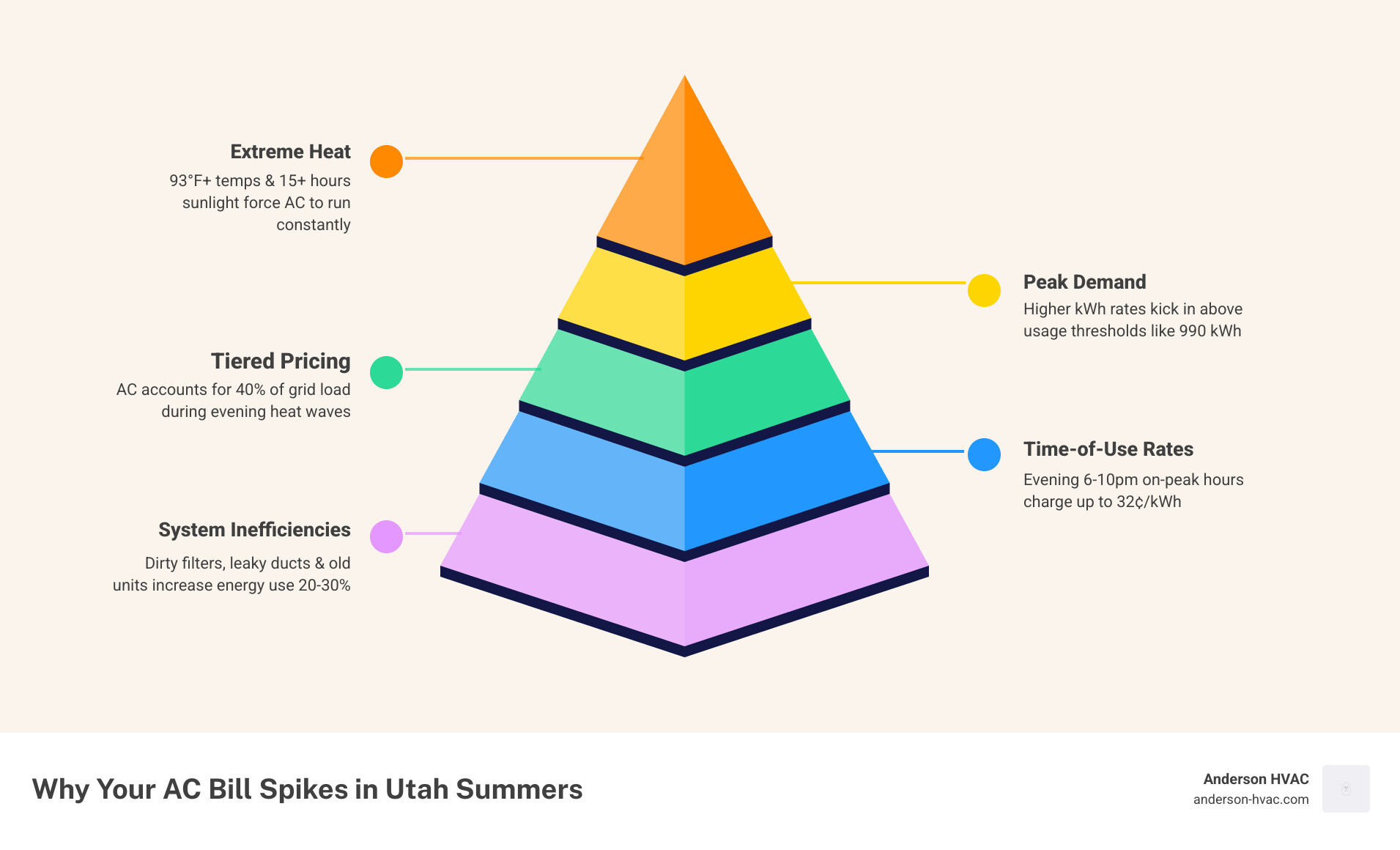
Why your ac bill spikes in utah summers comes down to a perfect storm of intense heat, long sunny days, grid-wide demand surges, and a pricing structure that punishes heavy usage. When outdoor temperatures regularly push past 93°F in July — and sometimes hit triple digits — your air conditioner stops being a convenience and starts being a necessity running nearly around the clock.
Here are the main reasons Utah summer AC bills spike so dramatically:
- Extreme heat and long daylight hours — Northern Utah sees 15+ hours of sunlight in midsummer, which means your home absorbs heat all day long, forcing your AC to work harder and longer
- Increased energy consumption — Average Utah household electricity use jumps from roughly 725 kWh in June to 990 kWh in July, a significant leap that pushes many homes into higher billing tiers
- Tiered pricing structure — Rocky Mountain Power charges more per kilowatt-hour as your usage climbs, so crossing certain usage thresholds means every extra kWh costs more than the last
- Peak demand hours — On weekday evenings, the entire grid is under maximum stress, and time-of-use pricing can make electricity during those hours significantly more expensive than off-peak times
- AC system inefficiencies — Dirty filters, leaky ducts, aging equipment, and low refrigerant all make your system burn more electricity to deliver the same amount of cooling
- Added summer loads — Pool pumps, electric vehicle charging, and extra appliance use from kids being home all pile on top of your baseline cooling costs
The result? Households in areas like Lehi and West Valley City commonly see their July electric bills run 30 to 60 percent higher than their spring bills — and for some, the bill nearly doubles.
The good news is that most of these drivers are manageable once you understand what’s causing them. This guide breaks down each factor and walks you through practical steps to keep your home cool without letting your utility bill spiral out of control.
The Science Behind Why Your AC Bill Spikes in Utah Summers
To understand the sudden leap in your utility bill, we have to look at the grid itself. During the hottest days of the year, air conditioning alone can account for up to 40% of the entire grid’s peak demand. As of May 2026, we are seeing more frequent heat waves that push local infrastructure to its limits.
When everyone in North Ogden, Layton, and Kaysville turns on their AC at the same time, the cost of generating and distributing that power skyrockets. Utilities must often fire up “peaker” plants—expensive, fast-acting generators—to ensure there isn’t a blackout. These costs are eventually passed down to us as ratepayers.

If you live in Kaysville, you might notice that your system seems to run constantly starting in mid-June. Ensuring you have a modern, high-efficiency setup is one of the best ways to combat these grid-level price hikes. You can find everything you need to know about new AC installation in Kaysville UT to see how modern units handle these loads more effectively.
Climate Factors and Long Daylight Hours
Northern Utah has a unique geography that complicates cooling. In the height of summer, we enjoy (or endure) over 15 hours of sunlight. While that’s great for a trip to Pineview Reservoir, it’s brutal for your home’s “thermal gain.”
Because our air is so arid, the sun’s radiation is incredibly intense. It superheats your roof and walls, and that heat radiates into your living space long after the sun goes down. This “heat radiation” means your AC doesn’t just work while the sun is up; it’s fighting the thermal mass of your house well into the night.
Understanding Peak Demand and Time-of-Use Pricing
In Utah, “when” you use power is becoming just as important as “how much” you use. Many residents are now on Time-of-Use (TOU) plans. These plans have a specific “on-peak” window—typically from 6 p.m. to 10 p.m. on weekdays—where the price of electricity can jump significantly.
During the summer months (June through September), Utah on-peak rates can hit over 32 cents per kWh, compared to an off-peak rate of roughly 7 cents. Furthermore, Utah uses a tiered billing scale. Once you cross the 400 kWh and 1000 kWh thresholds in a month, the price per unit of energy increases. This is why your ac bill spikes in utah summers so sharply once July hits; you aren’t just using more power, you are paying a higher rate for every single bit of it.
| Season | Avg. Monthly Bill (Lehi/WVC) | Avg. Usage (kWh) | Cooling % of Bill |
|---|---|---|---|
| Spring (April/May) | $120 | 650 – 725 | 5-10% |
| Summer (July/August) | $203 – $240 | 990 – 1,100 | 50-60% |
Common Household Culprits Driving Up Cooling Costs
While the weather and the grid play their parts, often the reason why your ac bill spikes in utah summers is hidden inside your own home. A system that is struggling mechanically will draw significantly more amperage to produce the same cooling effect.
One of the most common issues we see is airflow restriction. A clogged filter forces the blower motor to work overtime, which can lead to “short cycling”—where the unit turns on and off rapidly without ever reaching peak efficiency. If you’re in Clearfield and your unit is acting up, getting AC repair in Clearfield UT can often pay for itself in a single season of energy savings.
Common mechanical failures that spike bills:
- Low Refrigerant: If your system has a leak, it has to run twice as long to remove the same amount of heat.
- Dirty Condenser Coils: When the outdoor unit is covered in cottonwood fuzz or dirt, it can’t “dump” the heat from your home into the outside air.
- Failing Capacitors: These components help the motor start and run; when they weaken, the motor draws more power and runs hotter.
Inefficient Equipment and the Impact of Home Age
Utah is full of beautiful historic brick homes and post-war ranch-style ramblers. While these homes have character, they often lack the insulation and modern HVAC design required for 100-degree days. An AC unit typically has a lifespan of 12 to 15 years. If your unit was installed back in 2010, it likely has a SEER (Seasonal Energy Efficiency Ratio) rating that is half of what modern units offer today.
For our neighbors in Clinton, upgrading an old, power-hungry unit can be the most effective long-term solution. Learning everything you need to know about AC unit replacement in Clinton can help you understand how a modern SEER2-rated system can slash your monthly cooling costs by 20-40%.
Why Your AC Bill Spikes in Utah Summers Due to Leaky Ducts
Did you know that the average Utah home loses 20% to 30% of its conditioned air through leaky ductwork? If your ducts run through a scorching attic or a crawlspace, those leaks are essentially “cooling the neighborhood birds” instead of your bedrooms.
When ducts leak, it creates “static pressure” issues that starve your system of air. In some cases, especially in older homes in Kaysville, a traditional ducted system might be so inefficient that it’s worth looking into why your Kaysville home needs professional ductless AC repair or even a ductless mini-split installation to bypass those leaky old pipes entirely.
Strategic Ways to Lower Your Summer Energy Consumption
You don’t have to suffer in a hot house to save money. The U.S. Department of Energy suggests that the “sweet spot” for efficiency and comfort is 78°F when you are home. While that might sound high to some, using it in tandem with ceiling fans can make the room feel 4 degrees cooler due to the wind-chill effect.
Another great tip is to perform an “energy-efficient review” of your home. Small changes, like closing south-facing drapes during the day and ensuring your cold air returns aren’t blocked by furniture (like a piano or a couch), can have a massive impact. You can check out our Anderson HVAC energy efficient review 101 for a more detailed checklist.
Shifting Usage to Off-Peak Hours
If you are on a Time-of-Use plan, “pre-cooling” is your best friend. This involves setting your thermostat lower in the morning and early afternoon (off-peak) to “soak” the house in cold air, then raising the thermostat during the 6 p.m. to 10 p.m. peak window.
Other things to move to off-peak hours (after 10 p.m.):
- EV Charging: Electric vehicles can add 30% to your home’s energy use; always charge them overnight.
- Dishwashers and Laundry: These appliances add heat and humidity to the home, forcing the AC to work harder.
- Pool Pumps: If you have a pool, run the pump during the night to avoid peak demand charges.
If your current system can’t keep up with these shifts, it might be time for an upgrade. We often help residents with how to handle an AC system replacement in North Ogden to ensure they have the smart technology needed to automate these savings.
Long-Term Efficiency Upgrades and Maintenance
For those looking at the big picture, long-term investments can permanently lower the floor of your utility bills. Planting deciduous shade trees on the southeast and southwest sides of your home can provide natural cooling that reduces the load on your AC. Adding attic insulation to meet modern R-values is another high-ROI move.
However, the single most important thing you can do is schedule an annual tune-up. A professional technician can clean your coils, check refrigerant levels, and ensure all electrical components are drawing the correct amount of power. For those in Pleasant View, a well-maintained system is the best defense against a mid-summer breakdown. Check our homeowner’s guide to staying chilled in Pleasant View for more maintenance insights.
High-Efficiency Upgrades to Consider:
- Smart Thermostats: These learn your schedule and automatically adjust for peak pricing.
- Variable-Speed Blowers: These run at lower, more efficient speeds most of the time.
- High-SEER2 Units: Modern units are designed specifically for the extreme heat we see in May 2026.
Frequently Asked Questions about Utah Summer Cooling
Why is my July bill so much higher than June?
In Utah, July is typically 4-5 degrees hotter on average than June. While that doesn’t sound like much, it often pushes nighttime temperatures above 70°F. When the night stays warm, your AC never gets a “break,” and your home never sheds its thermal load. This constant operation, combined with crossing into the Tier 3 pricing bracket (over 1000 kWh), causes the bill to leap.
Does keeping the AC on all day save money?
Not usually. It is a myth that it takes more energy to cool a home down than to keep it at a constant temperature. The 7-10 degree rule is a better guide: if you’ll be away for 8 hours, raising the thermostat by 7-10 degrees can save you up to 10% a year on cooling costs.
How does a dirty filter affect why your ac bill spikes in utah summers?
A dirty filter is like trying to breathe through a straw while running a marathon. It starves the blower motor of air, causing it to draw more electricity. Even worse, it can cause the evaporator coils to freeze over. Once they freeze, the system will run 24/7 without actually cooling the house, leading to a massive bill and a potential system failure.
Conclusion
At Anderson HVAC, we’ve spent over 40 years helping our neighbors in North Ogden and throughout Northern Utah stay comfortable. As a family-owned business, we know that a sudden spike in your utility bill can be a major stressor. Understanding why your ac bill spikes in utah summers is the first step toward taking control of your home’s energy future.
Whether you need a simple tune-up to improve airflow, a repair to fix a refrigerant leak, or a full system upgrade to take advantage of modern efficiency, our team is here to help. We pride ourselves on individualized service that exceeds expectations—because we aren’t just your HVAC contractors; we’re your neighbors.
Don’t let the Utah sun drain your bank account. Schedule professional air conditioning services in North Ogden today and let our family help yours stay cool for less.

